
Truth or Fables
Exposing Seventh-day Adventist Fables
 2 Tim 4:4 (KJV) 4And they shall turn away their ears from the truth, and shall be turned unto fables.
Seventh-day Adventists from their beginning have turned from the "TRUTH"
the teachings of Jesus and the Apostles to the "FABLES" of their prophetess Ellen G. White.

Robert K. Sanders Editor

Established 1997 

[Home] [Subjects]  

Editor's Testimony
Contact Us
SEARCH
Links

Books

FAQ
Directory 
of Former SDA Pastors & Employees
Readers
Testimony
If you wish to receive information about the SDAs write  and I will put you on my
e-mail list.


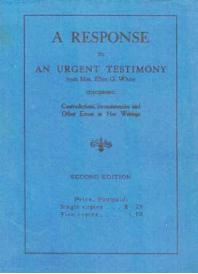
A RESPONSE TO
AN URGENT TESTIMONY

Doctor Charles Stewart wrote this book, first as a letter to Ellen G. White in response to her request for a letter from him as well as others in Battle Creek because they were questioning her conflicting testimonies she was sending out.

She invited these men to ask her questions:

Ellen G. White: "To Those Who Are Perplexed Regarding the Testimonies Relating to the Medical Missionary Work: "Recently in the visions of the night I stood in a large company of people. There were present Dr. Kellogg, Elders Jones, Tenny, and Taylor, Dr. Paulson, Elder Sadler, Judge Arthur, and many of their associates. I was directed by the Lord to request them and any others who have perplexities and grievous things in their minds regarding the testimonies that I have borne, to specify what their objections and criticisms are. The Lord will help me to answer these objections, and to make plain that which seems to be intricate." "Let those who are troubled now place upon paper a statement of the difficulties that perplex their minds, and let us see if we can not throw some light upon the matter that will relieve their perplexities. The time has come for the leaders to state to us the perplexities…" EGW, Quoted in Doctor Stewart's letter.

PAGE Contents:
Preface
7. A Response to an Urgent Testimony from Mrs. E. G. White.
8.
Mrs. White's Letter to the Sanitarium Workers.
12.
"I Am Not A Prophet."
13.
Workers are not to Sign A Contract.
14.
The Sanitarium is not A Denominational Institution.
15.
Dr. Kellogg Does and Does Not Believe The Testimonies.
17.
Testimonies For and Against Butter.
19.
A Catholic Woman Led Mrs. White to Quit The Use of Meat.
22.
Mrs. E. G. White, Eats Meat and Oysters.
23.
The Use of Medicines.
25.
Influenced By Others.
28.
Erection of Buildings In Chicago.
33.
Judge Arthur's Reply.
47.
Testimonies For and Against Dr. Kellogg.
61.
Rebuilding The Battle Creek Sanitarium.
69.
Facts About Mrs. White's Book, "Sketches From
The Life of Paul." (Plagiarism)
81.How Mrs. White Paid Tithes.
85 Comparing Dr. Cole with Mrs. E. G. White's Health Reform.
86.
Mrs. E. G. White's Inconsistent and Contradictory Testimonies.

Preface

    The major portion of this pamphlet was sent May 8, 1907, to W. C. White with the following request: " I am sending this to you so that you can give it personally to your mother if you think best. I do not wish to burden her with these things, but since she has said that the Lord wishes them sent and that he will help her to answer them, I shall leave the responsibility and results with her."

    The author of this letter informs us that he has written three letters on this subject to W. C. White, but nearly five months have elapsed and he has not even received the courtesy of a reply. However, the registration receipt properly signed was returned.

    We have no means of knowing whether or not Mrs. White received the letters, but we do know that Elder A. G. Daniells was duly informed about them and that he took occasion in a public meeting to severely criticize the author for doing exactly what Mrs. White wrote in the name of the Lord asking him to do. Notwithstanding the fact that the letter was written in response to an urgent testimony, Elder Daniells assumed the right to criticize, and we are informed by several who heard him and who later had an opportunity to read the letter, that his criticism was unjust because he did not mention the fact that the letter was written in response to a testimony.

    We have numerous evidences which might be presented to show that Elder Daniells has given this matter wide-spread publicity, but space prevents us from referring to more than one other instance. We quote from a letter from a S. D. A. minister under date of Sept. 19, 1907, as follows: "Elder Daniells told us at camp-meeting that there was being a book published at Battle Creek. . . . The book was about Sister White's writings. If the book breathes the Spirit of Christ and is in harmony with the Bible, then I should like a copy of it. Sister White has made mistakes in her writings, and it is only due to the people of the S. D. A. Church that they find it out so as to avoid false doctrines."

    The undue and unwise publicity given this matter has created such a demand for the letter that the author has been entreated by many to publish it, but he has steadfastly refused so to do, maintaining that he never intended that it should be made public only in so far as those who were desirous of knowing his views with reference to the matter, they would be allowed to read it. In this we have reason to believe he has kept his promise to the letter. In this connection we wish to state that neither the author nor any person or persons connected with the Battle Creek Sanitarium are responsible for the appearance of this letter in print.

    It seems that the time has come when the testimonies are being made a test of fellowship and since a comparatively small number of Seventh-day Adventists have an opportunity to know why some can not accept everything that is written by Mrs. White as being inspired, we believe that a general publication of the facts herein contained will be a means of enlightening many as to the cause of what some are pleased to call the "GREAT APOSTASY." For this reason a number of the lovers of truth have had this printed and distributed in the hope that all may have an opportunity to become familiar with the facts.

From Mrs. Ellen G. White      7

A Response to an Urgent Testimony
from Mrs. E. G. White

Mrs. E. G. White,
        Sanitarium, St. Helena, Cal.

    Under date of March 30 of last year there was sent to me a very urgent testimony written by you in which you requested all those having difficulties, concerning your testimonies to inform you concerning the same, and in which you assured me that the Lord would help you to answer the objections. Upon receipt of this I wrote and asked several questions which seemed to me to be of considerable importance, but in your answer all were ignored except one, the answer to which was clear enough.

    I have thought many times since that I would write you again, but when I thought of the many perplexing things you are called upon to consider, I felt that it would be cruel to burden you further; so for this reason I have not written. But I have just reread the testimony above referred to and find that it is very explicit and urgent in the request that all perplexities concerning the testimonies be referred to you for explanation, and since there are many things in your testimonies and other writings which seem to me to be contradictory and not in accordance with the facts as I see them, I take this

8          A Response to an Urgent Testimony

opportunity of complying with your request which is as follows:

" SANITARIUM, CAL., March 30, 1906.

"To Those Who Are Perplexed Regarding the Testimonies Relating to the Medical Missionary Work: "Recently in the visions of the night I stood in a large company of people. There were present Dr. Kellogg, Elders Jones, Tenny, and Taylor, Dr. Paulson, Elder Sadler, Judge Arthur, and many of their associates. I was directed by the Lord to request them and any others who have perplexities and grievous things in their minds regarding the testimonies that I have borne, to specify what their objections and criticisms are. The Lord will help me to answer these objections, and to make plain that which seems to be intricate.

    "Let those who are troubled now place upon paper a statement of the difficulties that perplex their minds, and let us see if we can not throw some light upon the matter that will relieve their perplexities. The time has come for the leaders to state to us the perplexities of which they have spoken to the nurses and to their associate physicians. Let us now have their reasons for talking with the students in a way that would destroy their faith in the messages that God sends to his people. Let it all be written out, and submitted to those who desire to remove the perplexities.

    "If statements have been made that there are contradictions in the testimonies, should I not be acquainted with the charges and accusations? Should I not know the reason of this sowing tares of unbelief?

From Mrs. Ellen G. White      9

    "Some who have gone to Battle Creek have spent many hours with nurses, presenting objections to the testimonies. Such ones would be able to spend more of their precious, God-given time in the study of the Word of God if with humble hearts they would follow the directions Christ has given, and present to me their grievances before they tell them to others. Men do not glorify God in spending so much time in long talks, which sometimes extend late into the night, in an effort to weaken the faith of those who are called to Battle Creek supposedly to be educated in medical missionary lines and fitted to go forth into any place where duty may call them.

    "I am praying for you all, and praying for our youth. It is time that we understood who is on the Lord's side. I ask that the leaders in the medical work at Battle Creek and those who have been associated with them in gathering together criticisms and objections to the testimonies that I have borne, shall open to me the things that they have been opening to others. They should certainly do this, if they are loyal to the directions God has given. We should also have a clear statement of facts from those with whom physicians and ministers have been at work, to undermine their confidences in the Bible, the Messages, and the Testimonies. If there is in your minds the thought that Sister White's work can be no longer trusted, we would be glad to know when and why you came to this decision. It may be that some matters that seem to you very objectionable can be explained. This will be better than to leave these matters

10        A Response to an Urgent Testimony

until the great future investigation, when every man's work will appear as it is, with the reasons that underly their course of action.

    "I am now charged to request those who are in difficulty in regard to Sister White's work to let their questions appear now, before the great day of judgment comes, when every work shall be made to appear with the motive underlying it, when the secrets of all hearts shall be known, and every thought, word, and deed shall be tested by the judge of the whole world, and each one will receive sentence according as his works have been.

    "I present this before you all. I am still praying for the physicians, the ministers, and the church in Battle Creek. If any are framing excuses that have deceived their own minds, I plead with them to put these excuses away before the final judgment, the great execution of the sentences that shall be passed upon all the earth. In the judgment there will be tried the cases of those who have been exalted to high positions of influence, those who have had great opportunities and great light, but who have refused to heed that light, because it did not agree with the desire of their own hearts. They have turned aside the counsel of the Lord to open the door to seductive influence, and are repeating the very experience that was set in operation in the heavenly courts.

    "There is a class who need to look well to the course of action they are pursuing, and to do the diligent work that is essential. 'Because thou sayest, I am rich, and increased with goods, and have need of nothing, and

From Mrs. Ellen G. White      11

knowest not that thou art wretched, and miserable, and poor, and blind, and naked; I counsel thee to buy of me gold tried in the fire that thou mayest be rich, and white raiment that thou mayest be clothed, and that the shame of thy nakedness do not appear; and anoint thine eyes with eyesalve that thou mayest see. As many as I love I rebuke and chasten; be zealous, therefore, and repent. Behold I stand at the door, I will come in to him, and will sup with him, and he with me. To him that overcometh will I grant to sit with me in my throne even as I also overcame, and am set down with my Father in his throne.'

M. H.                                                      (Signed) Ellen G. White"

  Sunday afternoon, Oct. 2, 1904, in the Tabernacle, before a very large audience you made the following statements which were taken down by an expert stenographer, and which have been verified by scores who heard the statements:

   "I know that those that have got the books that God has bidden me to write, when that hand trembled so that it seemed an impossibility—I want you to read the books, 'Patriarchs and Prophets,' 'Desire of Ages,' 'Ministry of Healing' is nearly done, and a great many other books."

  St. Helena, Cal., Feb. 14, 1901, to—:

  "I wish to be in as quiet place as possible, for private conversation is much more wearing on me than public speaking. I know that I have the special power of God when I am bearing my testimony before the people. I know the Lord will not leave me."

. . . "My Instructor said silence is eloquence even when before your supposed friends. You will be justified in keeping your words for public occasion." A Messenger - Review and Herald, July 26, 1906:

12  A Response to an Urgent Testimony

  I am not, as I said yesterday, a prophet. I do not claim to be a leader. I claim to be simply a messenger of God, and that is all I have ever claimed."   "When I was last in Battle Creek, I said before a large congregation that I did not claim to be a prophetess. Twice I referred to this matter, intending each time to make the statement, 'I do not claim to be a prophetess.' If I spoke otherwise than this, let all now understand that what I had in mind to say was that I do not claim the title of prophet or prophetess.

        In the testimony dated Feb. 14, 1901, above quoted, you state: "I know that I have the special power of God when I am bearing my testimony before the people." On Sunday, Oct. 2, 1904, when bearing your testimony before a very large audience in the Tabernacle, you stated "I am not, as I said yesterday, a prophet." In the Review of July 26, 1906, you stated that you intended to say, "I do not claim to be a prophetess," and that what you had in mind to say was: "I do not claim the title of prophet or prophetess."' Are we to understand from this that on this occasion the special power of God was not with you when you said, "I am not, as I said yesterday, a prophet," or is the statement in the Review incorrect!

From Mrs. Ellen G. White    13

SIGNING OF CONTRACTS

  Testimony in General Conference Bulletin of 1893, pp. 162, 163:

  "Before persons are admitted to our Missionary Training School, let there be a written agreement that after receiving their education they will give themselves to the work for a specified time. This is the only way our missions can be made what they should be."

  In a testimony written in 1888 you state:

  "The Sanitarium at Battle Creek has been built up under a pressure of difficulties. There have had to be decisive measures taken, contracts signed by those who were engaged as helpers that they would remain a certain number of years. This has been a positive necessity. . . . Thus it has been necessary in the Sanitarium at Battle Creek to make contracts binding those who connect with it as helpers, so that after they have been educated and trained as nurses and as bath hands, they shall not leave because others present inducements to them "

  Testimony to —, —, and —, St. Helena, Cal., Aug. 3, 1903, p. 4:

  "No man or woman is to bind himself or herself to serve for a certain number of years under the control of a medical association, ... I know that some have thought it is advisable for the workers in our sanitarium to sign certain contracts. But I know also that it is not in accordance with God's Plan for the workers to sign these contracts."

  Testimony to —, Elmshaven, San., Cal., Aug. 4, 1903:

  "Yesterday I sent you a letter containing the warning that has been given again and again. The workers in our institutions are not to sign contracts binding themselves to an institution for a certain number of years."


    For a number of years the managers of the Sanitarium Medical Missionary Training School, believing that they were working in harmony with the principles set forth in the above testimony which was printed in the General Conference Bulletin of 1893, and in the above testimony of 1888, which was published in a pamphlet entitled "Selections from the Unpublished Writings of Mrs. E. G. White," required that before persons were admitted to this school they should sign an agreement to give themselves to the work for a specified time. Later the managers were severely criticized for doing what the testimony of 1903 above quoted advised.

    Under the circumstances what was the duty of the managers of the Sanitarium Medical Missionary Training School? Which instruction should they follow that given in 1888 and that published in the General Conference Bulletin in 1893, or that given to Elders—, —,— in 1903?

  Testimony to — and    Sanitarium Board Jan. 11, 1899: 

"Our brethren in America who are engaged in medical missionary work can, by appealing to the outside people, obtain because theirs is not a denominational work.  

  Life Sketches of James White and Ellen G. White, page 382:

  "Though founded and managed by Seventh-day Adventists, the Sanitarium is not conducted on a denominational basis."

  Testimony dated Aug. 21, 1902:        

"It has been stated that the Battle Creek Sanitarium is not denominational. But if ever an institution was established to be denominational in every sense of the word, this Sanitarium was."


From Mrs. Ellen G. White      15

DENOMINATIONAL OR UNDENOMINATIONAL.

    How can the work of the Sanitarium Board be "not a denominational work" in any sense of the word whatever, since the institution which it conducts as is stated, was established to be denominational in every sense of the word"! What do these statements mean?

DOES HE BELIEVE THE TESTIMONIES?

Testimony to Elders —, —, —,dated
Feb. 21, 1899, page 7:

    "I know that when admonition and warnings have been given, Dr. Kellogg has not despised these warnings and set then aside. He has not worked in order to get rich. The work that is done to relieve suffering humanity is of more value to him than a world of gold. He has gathered in all of the outcast that he can that they may be uplifted and reformed and see God as their Restorer. God approves of his work in this line, let the brethren appreciate this work."

Testimony to — , dated Aug. 5, 1902:

    "I was instructed I have a message for you to bear to Dr. Kellogg, I thought, It will do no good. He does not accept the messages that I bear to him unless these harmonize with his plans and devisings."

    Testimony to Dr. Kellogg, dated at Elmshaven, San-

16        A Response to an Urgent Testimony

DENOMINATIONAL OR UNDENOMINATIONAL.

How can the work of the Sanitarium Board be "not a denominational work" in any sense of the word whatever, since the institution which it conducts as is stated, was established to be denominational in every sense of the word"! What do these statements mean?

DOES HE BELIEVE THE TESTIMONIES?

Testimony to Elders —, —, —,dated
Feb. 21, 1899, page 7:

"I know that when admonition and warnings have been given, Dr. Kellogg has not despised these warnings and set then aside. He has not worked in order to get rich. The work that is done to relieve suffering humanity is of more value to him than a world of gold. He has gathered in all of the outcast that he can that they may be uplifted and reformed and see God as their Restorer. God approves of his work in this line, let the brethren appreciate this work."

Testimony to — , dated Aug. 5, 1902:

"I was instructed I have a message for you to bear to Dr. Kellogg, I thought, It will do no good. He does not accept the messages that I bear to him unless these harmonize with his plans and devisings."

Testimony to Dr. Kellogg, dated at Elmshaven, San-

16        A Response to an Urgent Testimony

itarium, Cal., Nov. 12, 1902, three months and nine days later: "You tell me that you do not believe the messages I send you, but I know that this is not true."

    Series B, No. 7, Sanitarium, Cal., Jan. 1, 1904 (one year and eighteen days later) : "Thus it has been for years, and message after message has the Lord sent in warning, but the one to whom, they have been sent has refused to hear."

    At Tacoma Park, Washington, May 30, 1905, you stated: "When Dr. Kellogg receives the messages of warning given during the past twenty years: . . . then we may have confidence that he is seeking the light."

    In 1899: "Dr. Kellogg has not despised these warnings and set them aside."

    In August, 1902: "Dr. Kellogg does not accept the messages . . . unless these harmonize with his plans and devisings."

    In January, 1904: "Thus it has been for years, and message after message has the Lord sent in warning, but the one to, whom they have been sent has refused to hear."

    In May, 1905: "When Dr. Kellogg receives the messages of warning given during the past twenty years . . ."

    These five statements seemingly represent a very peculiar state of affairs as regards Dr. Kellogg's views of the testimonies. In 1899 he believed them; in August, 1902, he did not accept them; in November, 1902, three months later, Dr. Kellogg said that he did not believe,

From Mrs. Ellen G. White      17

but you said that he did; and only one year after this you said that for years he has refused to hear; and in 1905 you infer that he has not received your messages for twenty years. Please explain what is meant by these seeming contradictions.

HAS THE TIME COME TO DISCARD MILK, EGGS, AND BUTTER?

  Testimonies for the Church, Vol. 3, Nos. 21-25 p. 21:

  "We bear positive testimony against tobacco spirituous liquors, snuff, tea coffee, flesh meats, butter, spices, rich cakes, mince pies, a large amount of salt and all other exciting substances used as articles of food." Testimonies for the Church, Vol. 2, Nos. 15-20 p. 367:

  "Because we from principle discard the use of meat, butter, mince pies spices, lard, and that which irritates the stomach an destroys health."

  Testimonies for the Church, Vol. 2, No. 18, p 485:

  "One family in particular have needed the benefits they could receive from the reform in diet; yet

p. 18, 19

these very ones have completely backslidden. Meat and butter have been used by them quite freely, and spices have not been entirely discarded." Testimonies for the Church, Vol. 2, No. 18, p. 487:

  "I have a well-set table on all occasions. I make no change for visitors whether believers or unbelievers. . . No butter or flesh meats of any kind come upon my table." Testimonies for the Church, Vol. 3, p. 136:

  "Children are allowed to eat flesh meats, spices, butter, cheese, pork, pastry, and condiments generally. . . These things do the work of deranging the stomach, exciting the nerves to unnatural action and enfeebling the intellect." Testimonies     for the Church, Vol. 2, p. 362:

  "You place upon your tables butter, eggs, and meat, and your children partake of them. They are fed with the very things

p. 19.

that will excite their animal passions, and then you come to meeting and ask God to bless and save your children. How high do your prayers go?"

  Testimonies for the Church, Vol. 7, No. 35, p. 135:

  "Milk, eggs, and butter should not be classed with flesh meat. Let diet reform be progressive. Let the people be taught how to prepare food without the use of milk or butter. Tell them that the time will soon come when there will be no safety in using eggs, milk, cream, or butter, because disease in animals is increasing."


 From Mrs. Ellen G. White      19

    From the foregoing statements it is difficult to form an opinion as to what the Lord wishes us to understand with reference to the use of butter. Over thirty years ago your testimony states: "We bear positive testimony against . . . flesh meats, butter," etc., which seems to clearly indicate that butter as well as meat must not be used. In several other testimonies, parts of which are quoted, butter and flesh meats are classed together; but in a testimony written more than thirty years later, when butter was certainly much more liable to disease, you state: "Butter should not be classed with flesh meat," and give the impression that it can be used with some degree of safety at least. There is seemingly a mistake of some sort here. Please inform me as to the facts with reference to the matter.

HEALTH REFORM.

  Testimonies for the Church, Vol. 3, Nos. 21-25, p. 21, written in 1870:

"Above all things we should not with our pens advocate positions that we do not put to a practical test in our own families, upon our own tables. This

  Testimony written Aug. 30, 1894:

"When the selfishness of taking the lives of animals to gratify perverted appetite was presented to me by a Catholic woman, I felt ashamed and distressed. I saw it in a new light, and

 20 A Response to an Urgent Testimony

is dissimulation, a species of hypocrisy." . . .

  "We bear positive testimony against tobacco, spirituous liquors, snuff, tea, coffee, flesh meats, butter, spices, rich cakes, mince pies, a large amount of salt, and all other exciting substances used as articles of food." Testimonies for the Church, Vol. 2, No. 18, p. 487, written in 1868:

  " I have a well-set table on all occasions. I make no change for visitors whether believers or unbelievers. . . . No butter or flesh meats of any kind come on my table."

  Testimonies for the Church, Vol. 2, No. 18, p. 371, written in 1869:

  "I have not changed my course a particle since I adopted the health reform. I have not taken one back step since the light from heaven upon this subject first shone upon my pathway. I broke away from everything at once -—from meat and butter and from three meals. . . . I left off these things from principle.

  I said, " I will no longer patronize the butcher, I will not have the flesh of slain animals on my table."

  Sunnyside, Cooranbong, Oct. 5, 1898:

  "I have had workmen clearing land, building houses, breaking up the soil, doing the hardest. kind of work, and these have sat at my table, but not a particle of meat has been upon my table in any shape for the last five years. I found that I could take no half and half ground I must be firm and decided in regard to my diet.


From Mrs. Ellen G. White      21

 took my stand on health reform from principle and since that time, brethren, you have not heard me advance an extreme view of health reform that I have had to take back. I have advanced nothing but what I stand to to-day."  

    In the testimony written in 1868 you say, "No butter or flesh meats of any kind come on my table." In the testimony written the following year you state, "I have not changed my course a particle since I adopted the health reform. I have not taken one back step since the light from heaven upon this subject first shone upon my pathway. I broke away from everything at once— from meat and butter and from three meals. I left off these things from principle. I took my stand on health reform from principle and since that time, brethren, you have not heard me advance an extreme view of health reform that I have had to take back. I have advanced nothing but what I stand to to-day."

    In 1894, you state, "When the selfishness of taking the lives of animals to gratify a perverted appetite was presented to me by a Catholic woman, I felt ashamed and distressed. I saw it in a new light, and I said, I will too longer patronize the butcher, I will not have the flesh of slain animals on my table."

    Three parties, all Seventh-day Adventists, two of them officially connected with the denomination, state that for a number of years after you received the light

22        A Response to an Urgent Testimony

on health reform, that you ate meat and oysters. Two of these persons within the past ninety days told me personally that you ate oysters in their own home, on one occasion as late as 1890. Another stated that he saw you eating oysters in a restaurant.

    If you deny that you ate oysters and state that the statements of these two men are false, I will make an affidavit to this statement and give you the names of the two persons referred to so that they can be asked for an explanation.

    In a testimony to Elders Irwin, Prescott, Waggoner, and Jones, Feb. 21, 1899, you state as follows: "Dr. Kellogg needs the help of those who will co-operate with him, who will counsel with him. He has these now, but those who do not accept the light God has given on health reform, who subsist on the flesh of dead animals, who use narcotics and stimulants, can not represent the truth to others. God gave the light on health reform, and those who rejected it rejected God."—Series B, No. 6, p. 31.

    In patronizing the butcher and having meat on your table, were you in so doing practicing dissimulation, a species of hypocrisy its that you were advocating a position with your pen that you did not put to a practical test in your own family and upon your own table?

    Since you ate meat and oysters after the "light on health reform first shone upon your pathway," and in so doing took a "backward step" and went contrary to the light God had given you on health reform, were you in doing this in the same position as those described

From Mrs. Ellen G. White      23

in your testimony of Feb. 21, 1899 to Elders Irwin as follows: ". . . those who do not accept the light God has given on health reform, who subsist on the flesh of dead animals … can not represent the truth to others?

Series B, No. 6, p. 31.

    " God gave the light on health reform and those who rejected it, rejected God." During the period between 1868 and 1894 in which you ate meat and oysters and served meat on your table and in so doing, going contrary to the light God had given you—were your testimonies, other writings, and speeches just as truly and purely from the Lord as when you were living up to all the light you had?

THE USE OF MEDICINE.

  "How to Live," Chap. III, p. 62:

  "Medicines have no Power to cure, but will most generally hinder nature in her efforts."

  " How - to Live," Chap. III, p. 57:

  "Medicine deranges nature's fine machinery and breaks down the constitution. It kills but never cures."

  Testimony, Aug. 30, 1896:

  "A simple diet and the

  Sunnyside, Cooranbong, Aug. 29, 1898:

  "This is God's method, the herbs that grow for the benefit of man, and the little handful of herbs kept and steeped and used for sudden ailments have served tenfold, yes, one hundred fold better purpose than all the drugs hidden under mysterious names and dealt out to the sick."

  The Education our Schools Should Give, Aug. 26, 1898

24.  A Response to an Urgent Testimony

entire absence of drugs, leaving nature free to recuperate the wasted energies of the body would make our sanitariums far more effectual in restoring the sick to health."   "The true method of healing the sick is to tell them of the herbs that grow for the benefit of man. Scientists have attached large names to these simplest preparations, but true education will lead us to teach the sick that they need not call in a doctor any more than they would call in a lawyer. They can themselves administer the simplest herbs if necessary."

    A drug is defined by Webster as "any substance used in the composition of medicines," therefore the active principle of the herbs you refer to, which is extracted by steeping, is a drug. From this we naturally conclude that in steeping the herbs, some drug is extracted which, when used for the purpose of curing disease, would properly be called a medicine. Your testimonies state, "Medicines have no power to cure, but will most generally hinder nature in her efforts." "Medicine deranges nature's fine machinery and breaks down the constitution. It kills but never cures."

    "A simple diet and the entire absence of drugs, leaving nature free to recuperate the wasted energies of the body, would make our sanitariums far more effectual in restoring the sick to health."

    If medicines have "no power to cure," and derange nature's fine machinery and their entire absence is best, how can it be "God's method" to use steeped herbs, and

From Mrs. Ellen G. White      25

how can they be so beneficial in cases of sudden ailments?

    If "the true method of healing the sick is to tell them of the herbs that grow for the benefit of man," and if "true education will lead us to teach them that they need not call in a doctor any more than they would call in a lawyer," why have you so earnestly advised young men and women to become physicians and nurses, often stating that a consecrated physician could do vastly more than a minister in winning souls to Christ?

    In view of the many, many things you have said against the use of medicines and drugs, I can not comprehend why in a testimony under the caption "The Education Our Schools Should Give," you make such a positive statement as "The true method of healing the sick is to tell them of the herbs that grow for the benefit of man, and that it (true education) will lead us to teach the sick that they need not call in a doctor any more than they would call in a lawyer. They can administer the simplest herbs if necessary."

YEILDING OF JUDGMENT.

  Unheeded Warnings, South Lancaster, Mass., Nov. 27, 1901:
  "If my brethren look upon the warnings that they have received as being unimportant because of words that have been spoken and letters that have been writ-
  Testimonies for the Church, Vol. 1, Nos. 1-14, p. 563:
  "My health was poor, and my mental sufferings were beyond description. Under these circumstances, I yielded my judgment to that of others, and wrote what ap-

26. Response to an Urgent Testimony

ten to me, if they refuse to accept the Testimonies given through me because they think in their hearts, "Somebody has told her," they must bear the responsibility of the influence of their course of action upon themselves and others."

  "It makes me very sad to know that some have yielded to this temptation. The Lord has charged me to enter into no controversy with any one who, when a message comes, shall ask, Who has told Sister White? I am neither to affirm or deny such charges, but state the facts according to the instruction that God has given me at different times and in many places "

peared in No. 11 in regard to the Health Institute, being unable then to give all I had seen. In this I did Wrong."

  To Dr. Kellogg, Oct. 28, 1903:

  "When you received my letter, you were perplexed, and said, "Some one has misinformed Sister White regarding our work." But no mortal man had ever written to me that this building had been put up."


    In a testimony entitled "Unheeded Warnings," written in 1901, writing about the question of your being charged with being influenced by others, you make the positive statement that the Lord has charged you to enter into no controversy with any one who, when a message comes, shall ask, Who has told Sister White? "I am neither to affirm or deny such charges," but to state the facts, etc.

    In a testimony written in 1903, you make the following statement: "When you received my letter, you were

From Mrs. Ellen G. White      27

perplexed, and you said, "Some one has misinformed Sister White regarding our work. But no mortal man had ever written to me or told me that this building had been put up." Since the Lord charged you that you were neither to affirm or deny these charges, did you go contrary to the testimonies in 1903, when you apparently denied the charge that some one had misinformed you? Would it be just for any one under those circumstances to accuse you of being disloyal to the testimonies?

    Since on one occasion, as is stated in Volume 1 of your Testimonies, page 563, you yielded your judgment to that of others and in so doing did wrong, is it not possible that some of your other writings contain matter written while your judgment was influenced by that of others?

HOW MISTAKES MAY OCCUR.

To —, Oct. 5, 1898, p. 6:

    "I find under my door in the morning several copied articles from Sister Peck, Maggie Hare, and Minnie Hawkins. All must be read, critically by me. Sometimes I am utterly exhausted, then I can not read. That may be the reason that you had that statement in regard to meat-eating."

    In quite a number of your testimonies I notice that you refer to your being feeble and exhausted. Is it not possible that a considerable number of the seeming contradictions and inconsistencies in your writings are due to the fact that they slip through without your careful supervision? If this is so, are people to be criticized for

28        A Response to an Urgent Testimony

calling attention to such, and trying to find out the facts? Or, is it the duty of every one to say, "This is from Sister White, and it must be so because it is the Word of God?"

Spiritual Gifts,
The Great Controversy, by
Ellen G. White, 1858, Page 22:

  "Sorrow filled Heaven, as it was realized that man was lost, and the world that God created was to be filled with mortals doomed to misery, sickness, and death, and there was no way of escape for the offender."

Patriarchs and Prophets by
Mrs. E. G. White, Entered according to the Act of Congress, 1890. Page 69:Old Edition

  "The fall of man filled all heaven with sorrow. The world that God had made was blighted with the curse of sin, and inhabited by beings doomed to misery and death. There appeared no escape for those who had transgressed the law."

Why was this change made?

ERECTION OF BUILDINGS IN CHICAGO.

  In the early part of 1899 you sent Dr. K. a testimony in which you stated that Dr. K. had taken money from the Battle Creek Sanitarium to erect buildings in Chicago.

  Testimony to Sanitarium Board, Jan. 31, 1899:

  "I am directed by the Lord to call upon you to do something for us, and to do

  Testimony, Geelong, Victoria, March 10, 1900: "It galls my soul to think that though I have presented our necessities to the managers of the Battle Creek Sanitarium, the money that should have been used to provide this field with facilities has been absorbed in other enterprises. The Lord instructed

From Mrs. Ellen G. White      29

it now." … "Some division of your funds must be made for this purpose." An Appeal for the Work in Australia," 1899, p. 36:

"… the profits of the sanitarium should be largely used in helping similar institutions in needy circumstances."...


me that I had a right as his steward to call for means from the Battle Creek Sanitarium in Australia. Such an institution is greatly needed in this country and would accomplish far more than an institution of the same kind would accomplish in America. Light has been given me that the money which should have been used to establish this institution has been used in the work in Chicago. This was not a right disposition of the money. Dr. K. has established institutions and carried on a work which has consumed so much of the available means in one spot of the Lord's vineyard while other portions of the vineyard have been left without enough to make a beginning. This is a misconception of the mind and will of God, so much money should not have been absorbed in erecting buildings in one locality, but should have been used in carrying forward aggressive work in other parts of the field."

30        A Response to an Urgent Testimony

    It was a considerable time after the sending out of the first testimony relative to this matter before any explanation was given by you as to what was really meant, other than the plain statement of the testimony. It is evident that during this time you were under the impression that the buildings had been erected, because upon your return from Australia, when looking over the work in Chicago, you asked Dr. Paulson where the buildings were that had been erected.

    In further proof of this statement, we quote from a talk by you in June, 1902, as follows:

    "During the general meetings held here in June, 1902, I attended three meetings in the Sanitarium Chapel. I had a decided message to bear to the people. A heavy burden rested upon me to make a clear statement of the principles that should be followed in our medical missionary work. I was very thankful that Judge Arthur was present to hear the message that the Lord had given me. I asked the Lord for help, and was assured of His presence." . . .

"Shortly after the meetings closed, Judge Arthur and his wife spent part of a day at my home. We had much pleasant and profitable conversation. Among other things discussed was the matter of the representation that had been given me of an expensive building in the city of Chicago, used for various lines of medical missionary work. I related how that when I was in Australia, I was shown a large building in Chicago, which, in its erection and equipment, cost a large amount of money. And I was shown the error of investing means

From Mrs. Ellen G. White      31

in any such buildings in our cities." "I saw the expensive building above referred to, fall, with many others."

    "As I related some of these matters, and described the building that had been shown me, Judge Arthur said: 'I can tell you something in regard to that building. A plan was drawn up for the erection of just such a building in Chicago. It would have cost considerable money. Brother William Loughborough, of Battle Creek, drew up the plans, and several men occupying responsible positions in the medical work met together to consider the matter. Various locations were considered. One of the plans discussed was very similar to what you have described."'

    "Sometime after this [note date above, June, 1902] I was shown that the vision [given nearly three years ago] of buildings in Chicago and the draft upon the means of our people to erect them, and their destruction, was an object-lesson for our people, warning them not to invest largely of their means in property in Chicago, or any other city, unless the providence of God should positively open the way and plainly point out duty to build or to buy as necessary, in giving the note of warning." (Note.— The contemplated medical college building was to be erected by funds secured from the sale of 28 Thirty-Third Place which already belonged to the College— neither the Sanitarium nor the people were asked to contribute to this.)

    Why did you quote judge Arthur in June, 1902, when he specifically told both you and W. C. White that he did not remember the facts, but that he would send them

32        A Response to an Urgent Testimony

to W. C. White in a letter as soon as he returned home and got access to the records containing them? This letter was sent to W. C. White Aug. 27, 1902, but your statement was made June, 1902.

    Believing that wrong use was being made of the information given W. C. White and yourself in that only a few of the facts and some errors were being related, I asked the judge to give me the facts, which he has done in the letters quoted below, a perusal of which, together with the minutes of the meeting of the College Board, will quite fully explain:

April 18, 1907.

    According to promise I have looked up and enclose herewith the copy of my letter to Elder W. C. White, dated Aug. 27, 1902, relating to the Medical Missionary College building which it was at one time proposed to erect in Chicago. The circumstances which brought about this letter are as follows:

    While I was in California with Mrs. Arthur (I think it was the month of June, 1902), staying at St. Helena Sanitarium, one evening Elder W. C. White called upon me at the Sanitarium and remained in consultation with me until late at night with reference to various denominational matters that were at the time unsettled, and which it was proposed to lay before Sister White for her decision. In the course of this conversation I incidentally mentioned the fact of our having proposed at one time to erect this building. Elder White inquired more particularly into the circumstances connected with the matter, and then stated that what I had

From Mrs. Ellen G. White      33

said had somewhat explained to him a mystery connected with a testimony coming from Sister White referring to the erection of certain buildings in Chicago for medical missionary work. He asked me if I would give him a detailed statement of everything that occurred. I told him that I could not do that as very many of the facts and circumstances connected with the transaction had passed out of my memory, but that upon my return home I would look them up and write him the result of my investigation.

    The next day while out driving with Sister White and my wife, Elder White, who was with us, mentioned to Sister White the conversation on this subject that he had had with me the evening previous, and something more was said with reference to it, just what, I do not remember, except that I stated also to Sister White that I would write the facts in a letter to Elder White as soon as I returned home and got access to the records containing them.

Youre very truly,

JESSE ARTHUR.

JUDGE ARTHUR'S LETTER TO W. C. WHITE.

ELDER W. C. WHITE,

            Sanitarium, Napa Co., Cal.

My Dear Brother White:—

    I find it possible at this time to make for you the long-promised statement in reference to the action of the Board of Trustees of the American Medical Mis-

34        A Response to an Urgent Testimony

sionary College in the spring and early summer of 1899, looking to the erection of a large medical college building in the city of Chicago. The facts are as follows:

    During the last of May, 1899, Dr. A. B. Olsen, who was then Secretary of the Board of Trustees of the American Medical Missionary College, prompted by Dr. Bayard Holmes of Chicago, urged upon the Board the necessity of the Medical College becoming a member of the Association of American Medical Colleges in order to give it an assured standing and position among the medical institutions of this and other countries.

    In furtherance of this object, Dr. Olsen was appointed a delegate to attend a meeting of such Association which was shortly afterwards to take place. in the city of Columbus, Ohio, and make application in behalf of our medical college for membership. This he did, and such application was laid over to be acted upon at the next regular meeting to take place a year from that time.

    Upon Dr. Olsen's return, he reported that the principal objection urged against admitting our medical college to membership was the want of a suitable building in the city of Chicago. It was then determined by the Board to take steps at once looking toward the erection of such building. A building committee was appointed and consisted of A. B. Olsen, W. K. Kellogg, and myself. Dr. Olsen was chosen secretary of such committee and I selected chairman.

    The committee met and immediately formulated plans for the purchase of a site and the erection of such a

From Mrs. Ellen G. White      35

building, I was instructed as chairman of the committee to open negotiations looking either to the sale or mortgaging of No. 28 Thirty-third Place which the College owned, and otherwise taking steps to raise the necessary funds to purchase the site and erect the building contemplated. Dr. Olsen was instructed to procure suitable plans for the Co1lege building, which he did. The cost of the site and improvements was to be somewhere in the neighborhood of $100,000.00 or possibly more. The committee went to Chicago, looked over several sites, and finally settled upon one on Thirteenth Street, and negotiations were opened for its purchase.

    All this took place while Dr. J. H. Kellogg was absent from the United States in Europe. After our plans were quite well completed for the going on of the work, it was thought advisable to await Dr. Kellogg's return to this country before proceeding further with the matter. I learned through others that after the Doctor did return and was advised of what had been done, that he discouraged going on with the project. Just what reasons he assigned for doing so I don't think I ever knew.

    Confirmatory of what I have stated, I enclose here with copy of two notes written me by Dr. Olsen, one under date of May 30, 1899, and the other under date of June 25 of the same year. I also enclose copy of the minutes of a meeting of the committee held on the 26th day of June of the same year.

    The plans for the building were in my possession at one time, but I think were returned by me to Dr. Olsen and I have no doubt can be found among the archives

36        A Response to an Urgent Testimony

of the Medical College now in the possession of Dr. Stewart.

If I have omitted anything that is important for you to know in connection with this matter, write to me and if possible I will explain the omission.

Yours very truly,
JESSE ARTHUR.

    Nearly two years later at the General Conference held in Battle Creek, April, 1901, at which you were present, quite definite plans were formulated to secure from the people not $65,ooo but $100,000 or more for the purpose of erecting buildings for the Medical College. Several hundreds of dollars were raised at this time, and several thousands of dollars pledged.

    In the first attempt to erect a college building, it was definitely understood that the money was to come from the sale of No. 28 Thirty-third Place, and that the amount expended was not to exceed $65,000 in all. It was impossible to sell the place for over $50,000. Not a single dollar was raised in cash or pledges, for no effort was made at this time to secure the necessary funds except by Selling the property referred to, which was not accomplished, so the matter was dropped. At the General Conference in 1901, a plan was set on foot whereby it was thought a large sum of money could be raised for the purpose of securing the necessary buildings for the college, the records of the meeting which are quoted in this connection are ample evidence of this and also of the fact that there were others besides Dr.

From Mrs. Ellen G. White      37

Kellogg interested in the project. In this connection it might be proper to ask if the testimony in question would be applicable to W. C. White, A. G. Daniells, and O. A. Olsen, since they took such a prominent part in the effort to raise the money referred to.

    General Conference Bulletin, April 15, 1901, p. 289:
Fifth meeting if Int. Med. Miss. & Benev. Ass'n.

Dr. David Paulson:

    "We have an old building in Chicago. We do not know how soon we will have to move out of it. It is utterly unfit for sick persons. . . . I believe that God will move upon the hearts of some people to help us secure new quarters. I trust that God is speaking to some in this audience to interest them in this project."
J. H. Kellogg, p. 290:

    "I ask you, my friends, what are you going to do? This denomination has not done a thing, has not raised a penny, has not invested a single penny in the Medical Missionary College. We want one hundred thousand dollars. We are not going to be bashful. We want one hundred thousand dollars. We need twice that sum. You ask what we would do with it? We would put up a building in Chicago." . . .

    At this juncture considerable money was donated for this purpose, among the donors being Elder J. N. Loughborough and other ministers.

    At the sixth meeting of the I. M. M. B. A., April 17 (See Gen. Conf. Bulletin, p. 341) still more definite plans were laid for the purpose of securing funds for the erection of medical college buildings.

38        A Response to an Urgent Testimony

    W. C. White: "I am intensely interested in our schools and in no school am I more interested than in the Medical Missionary College. Our schools should have their buildings without rent, and therefore I offer a resolution:

    "Resolved, That we proceed to raise a fund for the purpose of providing necessary buildings for the American Medical Missionary College.
"I move the adoption of this resolution."

    A. G. Daniels: "I second the motion."

    W. C. White: "This idea is not new to you. But, brethren, the question with us is, Has the time come to make an earnest effort to lift in this matter, and put our medical missionary school where it will not have to pay rent? It seems to me that we can not fail to be proud of this school, or to appreciate the work it has done. . . . Shall we not manifest our interest in the Medical Missionary College by raising a fund that it may own its buildings, and thus be free from rental and interest? I believe that we would receive a great blessing in doing this." . . .

    O. A. Olsen: "I can heartily second all the remarks made by Elder White. It has been my privilege to be connected with the Medical Missionary College since its beginning, and I have always taken the deepest interest in it and its work. I am more glad than I can express in words to see the good that has been accomplished, the way that the work is opening and the indications that are coming into the meeting of a united effort in this line of work of spreading abroad the whole

From Mrs. Ellen G. White      39

gospel in all its parts. The move to give this aid to the Medical College by securing it a place to work in, is just as God would have it, and we shall all rejoice to see it. I am glad for this motion, and I am heartily in favor of it. I believe it is the right thing to do, and God will bless us in carrying it forward.

    "The question was called and carried, unanimously by acclamation— a rising vote was then taken, which was also unanimous

    In your testimony, given, in June, 1902, you state as follows: "Some time after this I was shown that the vision [concerning the erection of buildings Chicago given three years before]. . . , was an object-lesson for our people warning them not to invest largely of their means, in property in Chicago, or any other city." W.C. White stated to Judge Arthur that his statement about the Medical College building "somewhat explained to him a mystery" connected with a testimony coming from you, referring to the erection of certain buildings in Chicago for medical missionary work.

    Was this vision so mysterious to both yourself and your son that you did not comprehend its, significance for, nearly three years, and not until Judge Arthur incidentally mentioned a contemplated plan to, erect a medical college building in Chicago?

    Since you yourself, were ignorant of the facts how can the medical leaders be so severely criticized for failing to recognize a statement so plain as "The Lord has shown me that you have taken money from the Battle Creek Sanitarium to erect buildings in Chicago, when

40        A Response to and Urgent Testimony

it was known beyond any question of doubt that no building had been erected, and consequently that no money was taken from the Battle Creek Sanitarium for its erection. Furthermore the managers of the Battle Creek Sanitarium have never contemplated the erection of any sort of a building in Chicago for any purpose whatever."

    From a testimony dated, Elmshaven, Sanitarium, Cal., Oct 28, 1903, we quote as follows: "In the visions of the night a view of a large building was presented to me, I thought that it had been erected and wrote you immediately in regard to the matter. I learned afterwards that the building which I saw had not been put up." At the time of the vision you were evidently mistaken, for you thought that a certain thing which had not been done, had been done, and stated so in a testimony. Since the building was not erected, the statement about the expenditure of money for its erection must also be a mistake. You must also have thought that the money had been expended, and also thought that it had been taken from the Sanitarium.

    Since you wrote in such it positive manner that the Lord had shown you so and so with reference to the above matter it, but later having learned that this was a mistake, you state that you thought so and so about it. Is it not possible that a greater mistake was made in condemning the Sanitarium managers for doing something, that you thought had been done, when in reality it had not, neither had such a thing been contemplated by them?

From Mrs. Ellen G. White      41

    While Dr. Kellogg was in Europe, there was some talk of attempting to erect a medical college building in Chicago, a committee was appointed, and some sites looked at, and some rough sketches made, but further than this nothing was done, for there seemed to be no possibility of securing the money with which to erect it, and besides, when Dr. Kellogg returned from Europe, he was opposed to going ahead with the plan.

    The following, taken from the records of the American Medical Missionary College, will show just what was done with reference to the building just referred to:

    "The Board of Trustees of the American Medical Missionary College met Monday at nine o'clock, June 19, 1899, in the Hospital Committee Room, Battle Creek, Mich. Present, trustees Judge Jesse Arthur, Dr. H. F. Rand, and Dr. A. B. Olsen. Present on invitation, Dr. Wm. A. George and Dr. J. M. Craig; Judge Arthur being president pro tem., presided at the meeting.

    "The meeting was opened by prayer by Dr. H. F. Rand. Dr. Olsen then made a brief statement of his visit to the meeting of the Association of American Medical Colleges and stated that the American Medical Missionary College was not voted upon at the meeting, but action was deferred until another year. He then emphasized the importance of securing a suitable building for the College to be located in Chicago; he stated he believed that this would aid greatly in putting the College on a favorable basis before the world and secure a desirable recognition. That it should be remembered that the chief reason why the Board of Health of Illi-

42        A Response to an Urgent Testimony

nios did not recognize our school fully was because it had not a suitable building for clinical work and instruction.

    "After a free discussion of the matter, Dr. Rand offered and moved the adoption of the following resolution, which motion was seconded by Dr. Olsen, and unanimously carried and said resolution adopted; said resolution as follows:

    "Whereas, It is the sense of this Board of Trustees that this College should be provided with a suitable college building in the city of Chicago, as soon as possible, therefore be it resolved, That as soon as practical, a suitable site in said city be procured by lease or purchase and a college building be erected thereon, to be completed within a year from this date, and to cost not to exceed the sum of $65,000 in all; and that the property of this College known as No. 28 College Place, Chicago, Ill., be disposed of as soon as it can be sold at a reasonable price, and the proceeds of such sale be used in procuring such site and erecting such college building; and further, that a committee composed of Chairman Jesse Arthur, and the Secretary, Dr. A. B. Olsen, and Will K. Kellogg, who is invited to act as a member of the committee, of which invitation the secretary is directed to notify him, is hereby appointed to carry into effect the objects and purposes of the resolution with full power and authority to act in the premises, and further that said committee is requested to have

From Mrs. Ellen G. White      43

prepared plans and specifications for said building and submit to this Board for consideration."

    JESSE ARTHUR, Pres. pro tem.

A B. OLSEN, Secretary.

    This action was taken several months after your testimony relating to the Chicago building was received, but it never occurred to the Board that it in any way referred to the Medical College building, because it stated that a large building had been erected, and that money had been taken front the Battle Creek Sanitarium for the purpose.

    Since at the time your testimony was received, the college had not thought of erecting a building in Chicago, and no building had been erected, — how could one be justly criticized for saying that no building had been erected? And since the contemplated building of the Medical College was to be paid for by the proceeds of the sale of the property at 28 Thirty-third Place, which is worth about $50,000, and since no money was taken from or expected, from the Battle Creek Sanitarium for its erection, where does the misappropriation of funds by the Sanitarium Board come in? And furthermore, the plans adopted did not contemplate the erection of a large building, but to dispose of the building at 28 Thirty-third Place in order to secure a location and building better adapted to the needs of the medical students. It was never even suggested that the Sanitarium be in any way called upon to furnish the money for this enterprise.

44        A Response to an Urgent Testimony

    In a recent letter from your son, W. C. White, referring to the Chicago work, we quote as follows: "You may ask, 'Why was Dr. Kellogg reproved for a work being done by his associates while he was in Europe?' Mother says in answer to this, that "it is Dr. Kellogg's plans which have shaped the medical missionary work in Chicago," and that as matters are presented to her, 'whatever is done, he is the doer of it! "

    Does God accuse a man of being guilty of something he was entirely ignorant of and had no part in whatever except to disapprove of when he was informed of the facts?

  Hamilton, New Castle,

Jan. 3, 1899.

To the Sanitarium Board.

  Dear Brethren:
"I write to ask you if you will not make some substantial donations to our San. at Summer Hill, Sydney." . . . "Dr. Kellogg thinks he can raise a thousand dollars to furnish the building."

  "I am directed by the Lord to call upon you to do something for us, and to do it how." "Some division of your funds must be made for this purpose."

  An Appeal for the Work in Australia, 1899, p. 36:
  "The B. C. San. has re-

  Sanitarium Charter, 4595 - - Sec. 6. 3303  "All the funds of said Corporation shall be faithfully and exclusively used for the purposes thereof, as set forth in its articles, and the same shall be wholly used within the State."


From Mrs. Ellen G. White      45

ceived thousands of dollars in donations which should be passed over to institutions of other countries which are struggling for an existence. And more than this, the profits at the San. should largely be used in helping similar institutions in needy circumstances. I am now directed by the Lord to call upon you to do something for us and to do it without delay. Some division of your fund must be made for this purpose."  

    It might be of interest in this connection to state that you were quite a large stockholder in the Health Reform Institute, and that when it was proposed to reorganize, you were advised of the fact and you gave instruction to the managers of the Sanitarium as to the distribution of your stock. The minutes of the Sanitarium Board of June 25, 1899, contain the following:

    "A list of thirty-nine names from Sister White to become stockholders was read by the secretary and accepted."

    We also quote part of a letter from the secretary acknowledging the receipt of the names.

46        A Response to an Urgent Testimony

BATTLE CREEK, Mich., June 6, 1899.

ELDER W. C. WHITE,
"Sunnyside," Cooranbong, New South Wales.

    Dear Brother: I acknowledge receipt of your two blanks relating to Sister White's stock in the old Health Reform Institute. We are glad to receive the names sent, and will see that they are notified at once, as the time expires July 1st, but as the names have already been received and acted upon by the Board, we have dated them in June, and when signed and returned, they will be entered as stockholders in the Michigan Sanitarium and Benevolent Association. As you intimate in your letter, there are a number on the list who have had stock assigned them and certificates have been sent. We will forward to the others at once, also the Declaration of Principles. Elder Haskell sent us his name, and recommended a number who were already stockholders. We notice that your name is not on the list, but have included it. If you will sign the enclosed blanks, and also have the other parties sign and return, I will see that they are properly entered on our stockholders' book.

    It would afford us pleasure at any time to keep you informed in reference to the progress and general outline of the work. Anything I can do for you at any time in reference to any matters mentioned above, I will be glad to do it."

"With kind wishes to your mother and all friends,

                        Sincerely yours,

deB.     (Signed) W. H. HALL, Sec'y."

From Mrs. Ellen G. White      47

    When you authorized the distribution of your stock at the time of the reorganization, the Lord knew that one of the fundamental principles with reference to the distribution of the funds was that the same should be wholly used within the State.

    The stockholders may have been at fault in permitting the managers to reorganize in the way in which they did, but since they did reorganize tinder a charter which demanded that all funds be wholly used within the State, were they not morally and legally bound to respect the regulation of the "powers that be." Had the managers acceded to the demand, "I am now directed by the Lord to call upon you to do something for us and to do it without delay," would they not have violated the Bible instruction given in Romans 13:1, "Let every soul be subject unto the higher powers. For there is no power but of God: the powers that be are ordained of God?"

    While the demand, "some division of your funds must be made for this purpose," could not be granted, the managers of the Sanitarium did lend their best efforts toward securing money for you elsewhere and as a result several thousands of dollars were sent to you.

    Notwithstanding these facts Dr. Kellogg and the Sanitarium managers were severely criticized, apparently for the reason that they refused to send part of the Sanitarium earnings to Australia when they k new that by so doing they would be violating the charter under which they were organized. We say apparently for these reasons, because previous to 1899 the work of Dr. Kellogg

48        A Response to an Urgent Testimony

and his associates received the highest kind of commendation from you as is evidenced by the following quotations from your writings prior to this time:
"The medical missionaries are doing the long-neglected work which God gave to the church in Battle Creek. They are giving the last call to the supper He has prepared."

    "In order to be carried forward aright the medical missionary work needs talent. It requires strong and willing hands and wise discriminating management. But can this be while those in responsible places-presidents of conferences and ministers-bar the way?"

    "The Lord has moved upon Dr. Kellogg and his associates to do the work which belongs to the church, . . . and God has placed his precious work in the hands of those who will take it up and carry it forward."

    "If you feel no interest in the work that is going forward, if you will not encourage medical missionary work in the churches, it will be done without your consent, for it is the work of God and it must be done."

    Special Testimonies to Ministers and Workers, No. 10, March, 1897, p.1:
"I wish to say that the work that is being done by Dr. Kellogg is not to be regarded as a strange work, for it is the very work that every church that believes the truth for this time should long since have been doing.... It is a work of God's own appointment."

    The Danger of Rejecting Light,— Feb. 6, 1896:
    "You are worried and perplexed because Dr. Kellogg is gathering disproportionately in the medical mis-

From Mrs. Ellen G. White      49

sionary work because his work far exceeds the work being done in the churches by the General Conference. What is the matter? It is plain that the light given by God has not been acted upon. Men have supplemented God's plans by their own plans. The prosperity of the medical missionary work is in God's order. This work must be carried to the highways and the hedges."

SUNNYSIDE, COORANBONG, May 19, 1898.
Dear Brother Irwin:

    The complaint comes, Dr. Kellogg has gathered up all the young men he can get, and therefore we have no workers. But this is the very best thing that could be done for the young men and the work. To you, as President of the General Conference, and to Brother Evans, as president of the General Conference Association, and to Brother Durland, as President of the Michigan Conference, I would say, Continue to work with tact and ability. Get some of these young men and young women to work in the churches. Combine medical missionary work with the proclamation of the third angel's message. . . . Send out into the churches workers who will get the principles of health reform, connected with the third angel's message, before every church in Michigan. See if the breath of life will not come into these churches." . . .

    "The indifference among our ministers in regard to Health reform and medical missionary work is surprising. Even those who do not profess to be Christians treat the subject with greater reverence than do some

50        A Response to an Urgent Testimony

of our own people, and they are going in advance of us."

    "Brother Irwin, take hold of health reform. If any of our ministers have the idea that the medical missionary work is gaining undue preponderance, let them take the men who have been working in these lines with them into their fields of labor, two here and two there. Let the ministers receive these medical missionaries as they would receive Christ, and see what work they can do."

    Feb. 21, 1899—To Elders Irwin, Prescott, Waggoner, and Jones:
"Dear Brethren: All in responsible positions, every minister in the Conference, are to be true yoke-fellows of Dr. Kellogg. All who from God and Jesus Christ whom he has sent, should acknowledge that Dr. Kel1ogg has been instructed by the mighty Counselor."

    "The message of truth has gone from the Sanitarium at Battle Creek to all parts of the inhabited world."

    "The world must have the light. Medical missionary work gives opportunity to communicate light and to present our faith to those of all classes and all grades of society. This work ought to have been done; and would have been done if God's people had been converted to the truth; if they had studied the Word with humble hearts, if they had reverenced the Creator of the world instead of exalting themselves and seeking, as many have done, to counterwork Dr. Kellogg's influence."

    "Would that there were men who had the same zeal for the Master, the same courtesy, the same love for the

From Mrs. Ellen G. White      51

truth of God that Dr. Kellogg has. He has not betrayed his trust. The Lord has wrought with him in his surgical operations, giving him wisdom and success that the world marvels at."

    "I know that when admonitions and warnings have been given, Dr. Kellogg has not despised these warnings and set them aside. . . . The truth is going forth from the Sanitarium at Battle Creek as from no other center in our work."

    "Let no man think it is his prerogative to plan the way in which Dr. Kellogg shall work." . . . Neither Bro. M— nor any other Brother need suppose that God has laid upon him the burden of settling Dr. Kellogg in right methods of work."

    In 1899 when the leaders in the medical work could not conscientiously accept the message in which you stated that they had taken money from the Battle Creek Sanitarium to erect buildings in Chicago, you sent a message in which you severely reprimanded these same men for carrying on this work in such an aggressive manner. In some of these messages, "An Appeal for the Work in Australia," p. 13, you state as follows:
"Time and means are being absorbed in a work which is carried forward too earnestly in one direction. . . . .The Lord has not appointed this."

    If the Lord did not appoint this, why did He so highly commend it, and why were the results so eminently satisfactory? In another message received in 1900, you state concerning the medical missionary work in Chicago: "I have no hesitancy in saying God did not

52        A Response to an Urgent Testimony

set you at that work in Chicago." Another accused Dr. Kellogg of misappropriation of funds. If God did not set Dr. Kellogg at this work in Chicago, why did he (Dr. K.) receive the following message from you? "I am more than pleased with the work that is being accomplished for a class that never would be restored unless merciful, compassionate hands reached TO THEM WHERE THEY ARE."

    Other statements of criticism were received during 1899 and 1900, but all seemed to be directed at the medical leaders because they failed to comply with your request to send money to Australia.

    In the spring of 1901 when on your way to the General Conference in Battle Creek, you had an opportunity to study the medical missionary work in Chicago — it was on this occasion that you asked "where are the buildings"— and later to come in contact with the work in Battle Creek, your views with reference to the work seemed to change somewhat, as will be seen by what follows:
When considering the matter of attending the Conference to be held in Battle Creek in the spring of 1901, you stated as follows:

    "Well, while I was praying and was sending up my petition, there was as on other times, — I saw a light circulating right round in the room; and a fragrance like the fragrance of flowers, and the beautiful scent of flowers, and then the Voice seemed to speak gently, and said that I was to "accept the invitation of My servant, John Kellogg, and make his house your home. Then the word

From Mrs. Ellen G. White      53

was, 'I have appointed him as My physician. You can be an encouragement to him.' That is why I am here, and that is why I am at his home. Now I want in every

St. Helena Elmshaven Feb. 23, 1901 

Dr. Kellogg   Dear Brother 

I have been in some trial in reference to the movements that it is wisdom for me to make, many letters were received and different times opened for and welcoming me, and I appreciate these hearty kind of letters, Friday we assembled to have our usual season of prayer I laid my case before the Lord and entreated most earnestly for the Lord to indicate my duty Dr. Kellogg had been the first to write me and I had felt it was best for me to accept his wholehearted invitation. Will the Lord instruct me. While praying I seemed to be surrounded with light and a voice said respect the courtesy of my servant John Kellogg the physician by my appointment. 

            He needs encouragement, that I can give him. Let him put his trust in Me, My arm's strong to uphold and sustain. He may safely lean upon my strength. I have a work for him to do. He must not fail or be discouraged."

(Signed) Ellen G. White 

way possible, if I can, to treat D. Kellogg as God's appointed physician, and I am going to do it."

    "Now God has not blessed us as he would have blessed us had there been an appreciation of the work that He is carrying on. I thank God that Dr. Kellogg has not sunk into despondency and infidelity. I have been afraid

54        A Response to an Urgent Testimony

of it, and I have written some very straight things to him, and it may be, Dr. Kellogg, — if he is here, — that I have written too strong; for I felt as though I must get hold of you by the power of all the might I had. But I have seen the work that has been carried on; and how can anybody see it and not see that God is at work? That is the mystery to me. I can not understand it. I, can not explain it."

    Your testimony of Feb. 27, 1900, to Dr. Kellogg states, "I have no hesitancy in saying that God did not set you at that work in Chicago." One year later, just a few days after you investigated the medical missionary work in Chicago, and at the time when the Lord called Dr. Kellogg "My servant," and appointed him as His physician, you state with reference to the medical missionary work as follows: "But I have seen the work that has been carried on, and how can anybody see it and not see that God is at work? That is the mystery to me. I can not understand it, I can not explain it."

    General Conference Bulletin, 1901, p. 25: Mrs. E. G. White: "The institution under the management of Dr. Kellogg has done a great work for the education of the youth. It has sent forth more workers in the cause in medical missionary gospel lines than any other agency I know of among our people throughout the world. And I ask how have you treated the matter? . . .

    Page 184: "Do not divorce yourselves from the medical missionary work. Dr. Kellogg has been almost driven to despair as he has sought for some way in

From Mrs. Ellen G. White      55

which he could bring the truth more prominently before the world ... . . .

    "I will tell you of a place where the workers labor on economical lines, where they may be even too economical. This is at the Sanitarium."

    General Conference Bulletin, 1901, p. 203: Mrs. E. G. White: "Over and over again instruction was given that our health institutions were to reach all classes of people. . . . When I heard that Dr. Kellogg had taken up the medical missionary work, I encouraged him with heart and soul, because I knew that only by this work can the prejudice which exists in the world against our faith be broken down."

    "Dr. Kellogg has been carrying too heavy a load, and our own people have been standing by, warring against him. [Do you sanction the present warring against him?] His work has been made heavier and harder because of lack of sympathy shown by those who ought to have seen the importance of the work he was doing."

    "Cautions were given Dr. Kellogg' showing him that his work was to reach the higher classes by maintaining the very highest standard in the Sanitarium. This is the only way in which the higher classes can be reached, and I felt that our people are highly honored because God has placed among us an instrumentality that could reach the higher classes." . . .

    "I encouraged Dr. Kellogg all I could. . . . He did not need any of your discouragement. The responsibility of the lives in his hands was enough. As he prayed

56        A Response to an Urgent Testimony

about his work and then took up the most difficult cases where if the knife had slipped one hair's breadth it would have cost a life, God stood by his side, and an angel's hand was upon his hand guiding it through the operation. All human beings are of value in the sight of God, because they are purchased by the blood of his only begotten Son. He wants every one to stand in close connection with him. . . The medical missionary work is doing this and it should have the support of every one of you."

    (At the present time, as in the past, before operations are performed all those who perform and assist in the operations have a season of prayer, and the results of these operations are even more successful than they were in 1901 and previous to this time. Since the success in 1901 and prior to this was attributed to the God's standing by the surgeon's side, and an angel's hand upon his hand, is the greater degree of success which accompanies the surgical operations at the present time attributed by you to the same watchful care of our Heavenly Father and his angels?)

    "I wish to tell you that soon there will be no work done in ministerial lines, but medical missionary work."

    "You will never be ministers after the gospel order till you show a decided interest in the medical missionary work, the gospel of healing and blessing and strengthening." . . .

    "God wants every soul to be imbued with the Holy Spirit. He wants those who have felt it their duty to circulate disparaging reports about Dr. Kellogg and the

From Mrs. Ellen G. White      57

medical missionary work to be converted. Take hold of the gospel ministry as it really is."

    During the spring of 1901 when you stated before a large audience in the College library that God was in the medical missionary work and that he called Dr. Kellogg "My servant" and appointed him as "His physician," you also at this very time (April, 1901) recommended that Dr. Kellogg be ordained to the ministry, and in a testimony to Dr. S—, dated October 12, 1901, stated as follows: "I hope you will not refuse the invitation which Dr. Kellogg has given you to go to Battle Creek and spend " some time there. . . . I hope that you will go to Battle Creek; for I must tell you that the counsel the Lord has given me for you is that you should be associated with other physicians. . . . The counsel given me by the Lord for you is that you should connect with' the physicians at Battle Creek, regarding yourself as one who needs additional qualifications to those you now have. I have a deep interest in you, and I greatly desire your success. But you can not be what you should be in all lines until you associate with other competent, trustworthy physicians. God says of Dr. Kellogg, 'He is my physician.' Respect him and sustain him." During this period Dr. Kellogg was preparing the "Living Temple," the teachings of which you, two years later, claimed the Lord showed you would "sweep away the whole gospel economy."

    Is it possible that the Lord would so fully indorse a man and his work as you claim that the Lord did that of Dr. Kellogg, when he was engaged in preparing a

58        A Response to an Urgent Testimony

work that would tend to undermine the principles of the Christian religion?

    Your endorsement of the work was so convincing that the General Conference Committee was encouraged to take hold, and after due consideration a committee was appointed to further it, and as a result the "Forward Movement" was organized. The following, copied from the Review and Herald of Dec. 31, 1901, will further explain the objects of this movement:

"THE FORWARD MOVEMENT.

A Revival of the Study and Practical
Application of the Physical Side of
Spiritual Truth in its Relation to the
Second Advent of Our Lord:

"PREPARE YE THE WAY OF THE LORD."

    "We are living in the time when the earth should be lightened with the glory of the message which is to prepare the Way for the coming of the Lord. It is time for the truth to shine forth. The light of life must reach all those who sit in darkness. It is a time of privilege and a time of opportunity. "Arise, shine; for thy light is come." We have been strangely slow to appreciate the meaning of the light committed to us, and slow to impart it to others. It is plain that a decided advance must be made. There must be an awakening .and a new experience among all his people,"

    "The very circumstances as shaped by the providence of God seem to indicate that the time has come for a

From Mrs. Ellen G. White      59

genuine revival of interest throughout the whole denomination in that phase of the gospel truth which relates to the body as the temple of the living God. It has been a long time since there was such a general movement of this kind. In the meantime a whole new generation has grown up, and many thousands have received the message. It is true that these truths have been taught among us during these years, but their importance as an integral part of the message gospel has not always been appreciated, and in too many cases their practical application has been largely neglected. During these years there has been a wonderful increase of light, and a development of the truths which were but dimly perceived in former years, so that to-day there is offered to this people a system of truth dealing with the principles which govern our physical well-being, such as has not been committed to any other people since the days of Israel. These facts and their meaning were considered at the Council of the General Conference Committee and other brethren, which was held in Battle Creek, Oct. 23 to Nov. 3, 1901, and it was decided to conduct a special educational effort in behalf of the gospel of health for at least six months, beginning with January, 1902. This work has since been placed under the direction of a central committee composed of the following persons: W. W. Prescott, Chairman; J. H. Kellogg, W. A. Spicer, G. W. Thompson, A. J. Read, E. R. Palmer. The general scope and purpose of this effort are indicated by its name, "The Forward Movement: A Revival of the Study and Practical Application of the Physical

60        A Response to an Urgent Testimony

Side of Spiritual Truth in its Relation to the Second Advent of Our Lord." We hope to make this a real forward movement in Christian experience, based upon a study of the complete gospel for spirit, soul, and body. We hope to set forth the right way of living, the pathway of an intelligent faith in the revelation of God's life, and thus to have teaching positive rather than negative. It will be a study of the gospel of life, the gift of God's life to man, and how to co-operate with God's purpose in this gift.

    In order to carry out the design to make this movement a general one, the central committee has suggested the forming of local committees in the different parts of the field, to direct the work in their several districts, especially in the matter of health conventions and other meetings for practical instruction in the application of the principles studied. The central committee has also asked the co-operation of the editors of all our publications in the United States, and as far as practicable in other countries, that space may be granted for articles by special writers, a large number of whom have been asked to contribute.

    "A book is also being written by Dr. J. H. Kellogg for use in this movement. This book will contain twenty-six chapters, thus providing one chapter as the basis of a study for each week during the six months. The title of the book, "The Living Temple," suggests the general plan of the work. Viewing the body as the temple of the Holy Ghost, the writer gives such instruction in the essential principles of anatomy and physiology

From Mrs. Ellen G. White      61

as will enable one to apply intelligently in daily life those rational methods for the preservation of health and the cure of disease which are based upon Biblical principles, and attested by a long experience.

    This book will be ready about the first of February. In the meantime there will appear in our different publications articles which will present some of the fundamental principles upon which the studies in "The Forward Movement" will be based.

    "The hearty co-operation of all the people is earnestly asked for, that this effort may be the means of real and permanent blessing. More definite suggestions for organized efforts will be made later, and through other channels which we hope will commend themselves as worthy of being adopted. It has been decided to merge the Reading Circle into this larger educational effort, and that work will therefore not be carried forward as a distinct department. It is for this reason that no announcements have appeared concerning it.

    "The headquarters of this movement will be at the office of the General Conference, and any correspondence relating to it should be addressed to "The Forward Movement," 267 W. Main St., Battle Creek, Mich., U. S. A. In behalf of the Central Committee,

(Signed) W. W. PRESCOTT, Chairman.

THE REBUILDING OF THE BATTLE CREEK SANITARIUM.

Series B. No. 6, 1904.

    "The Battle Creek Sanitarium was erected against the expressed will of God. Presidents of Conferences

1.     A Response to an Urgent Testimony

and others were consulted, it is true, and they assented to the plans presented, because they did not desire to differ with the leader of the medical work, when they could possibly agree with him. And besides, they had not received all the messages that he had received. Those who had not seen the testimonies that the leaders in the medical work had seen, were not responsible for what they did not know."

(a) The Sanitarium was erected against the expressed will of God.

(b) Presidents of Conferences and others assented to the plans because they did not desire to differ with the leader of the medical work when they could possibly agree with him.

(c) Presidents of Conferences and others had not received all the messages that the leaders in the medical work had seen.

    The Sanitarium was burned Feb. 18, 1902, therefore if God expressed his will with reference to its rebuilding, He probably did so after Feb. 18, 1902. Prior to this there was apparently no occasion for an expression concerning the rebuilding. For several years previous to the fire the leaders in the medical work had done everything that they possibly could to "establish plants in many places," and as a result between sixty and seventy centers had been established in this and foreign countries during the past ten years. This branch of the work had grown to such an extent that you cautioned us not to be so aggressive. "The medical missionary work is not to be made all and in all."—Vol. 8, p. 161.

From Mrs. Ellen G. White      63

    Several other statements to the same effect are to be found in your writings.

(a) If the Sanitarium was erected against the expressed will of God, some evidence of such an expression should be in evidence, and after a diligent search we find in Series B, No. 6, p. 5, under the title, "The Burning of the Sanitarium," dated St. Helena, Cal., Feb. 20, 1902, the following:

    "To-day we received the sad news of the burning of the Battle Creek Sanitarium." And from page 9 of the same testimony under the caption, "A Solemn Caution," we quote as follows: "A solemn responsibility rests upon those who have charge of the Battle Creek Sanitarium. Will they build up in Battle Creek a mammoth institution, or will they carry out the purpose of God by making plants in many places?